Description
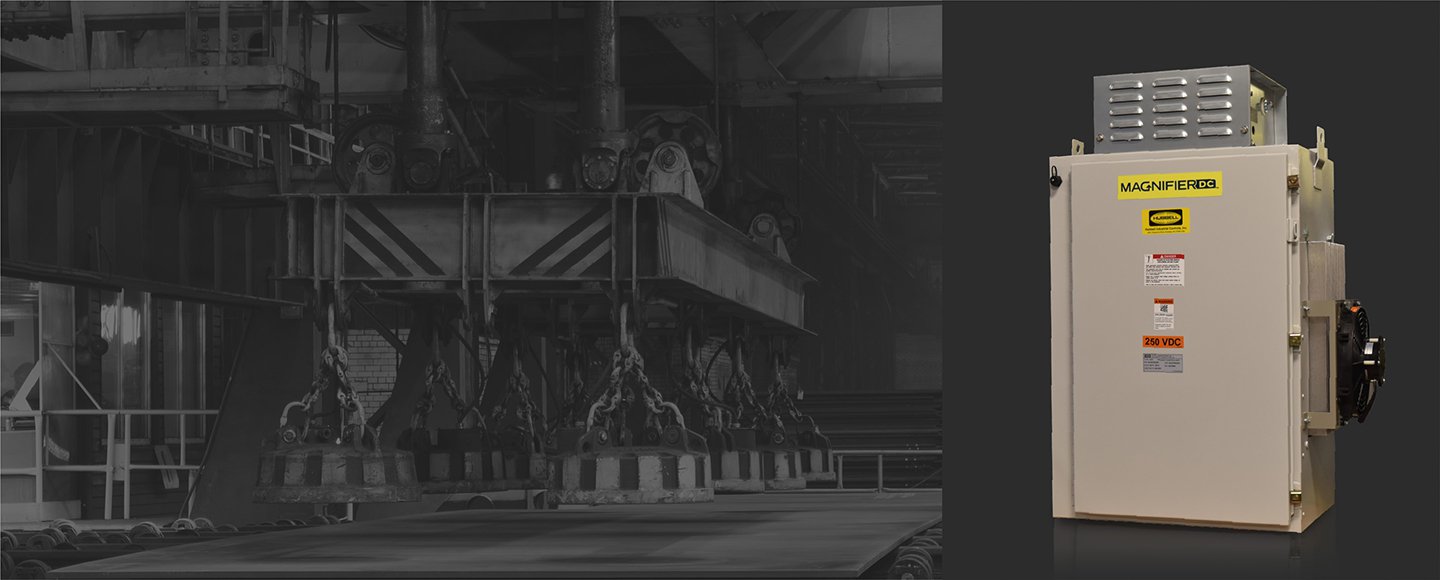
The complete hoist control system consists of a power transformer, a
silicon bridge rectifier and the hoist controller with accessories.
- The power transformer is a totally enclosed, nonventilated
(TENV), three-phase unit with delta connected primary and a
three-phase wye-connected secondary.
- The rectifier unit is a three-phase full wave bridge with diodes
in parallel for redundancy. Rectifier protection is provided by
fuses in each leg and a surge suppressor and snubbing circuit on the
dc side. Output of the rectifier is 300V dc.
- The hoist controller is a standard dc dynamic lowering controller
arranged for operation from 300V dc power. The controller
components are all front-mounted, front-removable, and front-wired.
Features
All the advantages of a dc hoist controller on an ac crane:
- Rugged dc series wound mill motor.
- Reliable dc series wound brake.
- Time-proven dc dynamic lowering hoist circuit.
- High-speed hoisting and lowering of empty hook or light loads.
- Slow, stable hook speeds hoisting and lowering with all loads.
- Reliable dc dynamic lowering with motor connected as a generator
and loaded with the dynamic braking resistor.
- "Off-point" braking because of spring-closed dynamic braking
contactor.
A hoist control system with rectifier output of 360V dc is available
as an option. Such a system operates at higher speeds than the
300V dc system, resulting in a reduced duty time of about 15%.
|